XYZ Work Board r2 · product firmware
I developed the product firmware for XYZ Work Board r2, connecting its new hardware platform to configurable controls and a coherent user experience.
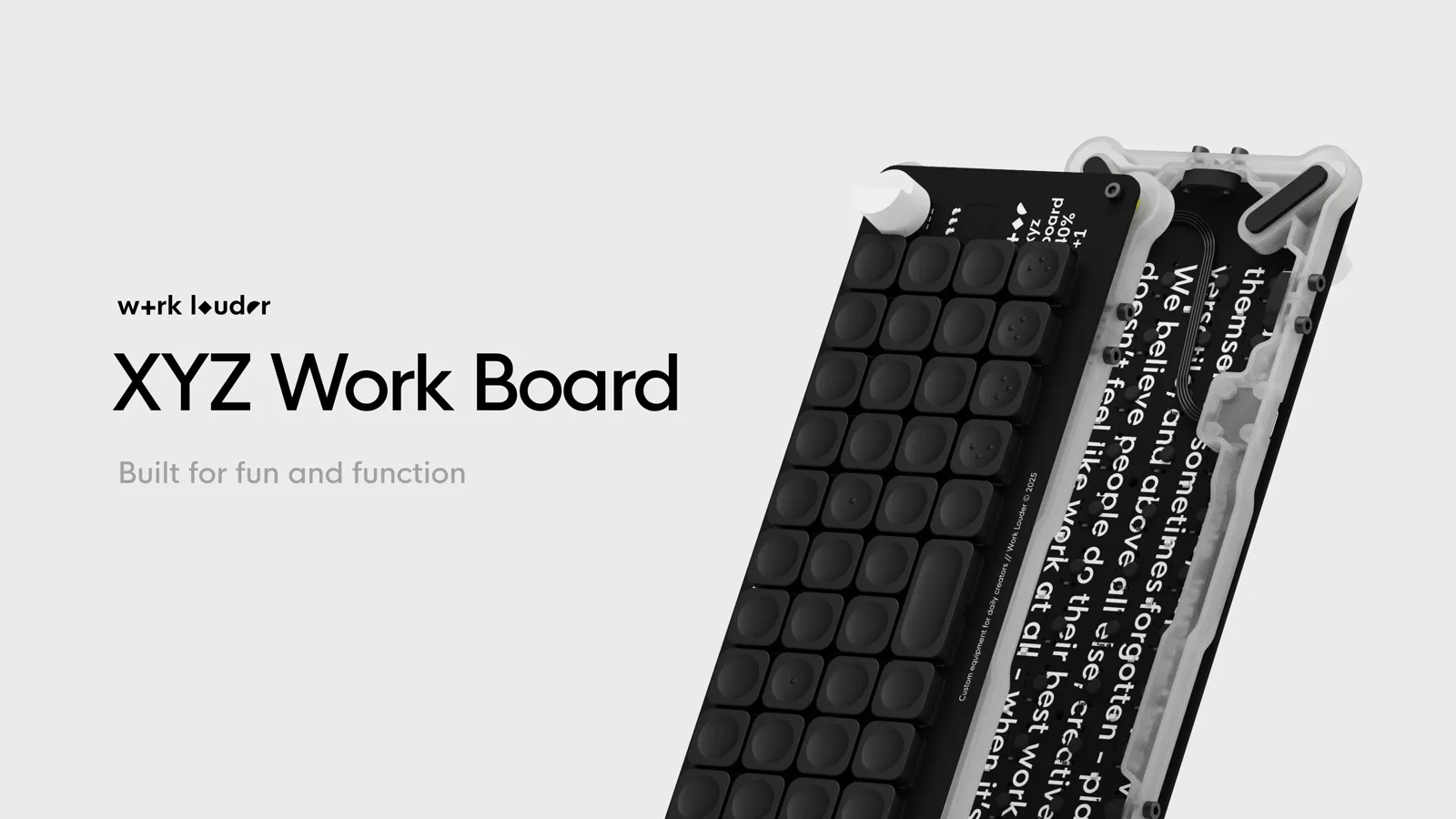
Turning a platform into a product
XYZ Work Board r2 is a compact programmable keyboard from Work Louder. It offers configurable physical controls and integration with Work Louder Input in a format designed to adapt to different workflows.
The value of the product does not come only from the components on its board. It comes from how the firmware turns those controls into coherent and customizable behavior.

XYZ Work Board r2, a programmable keyboard developed by Work Louder.
The public configuration includes 47 keys, one rotary control, a touch control, LED indicators, and onboard memory. Through Work Louder Input, users can organize actions, layers, and profiles around the applications they use.
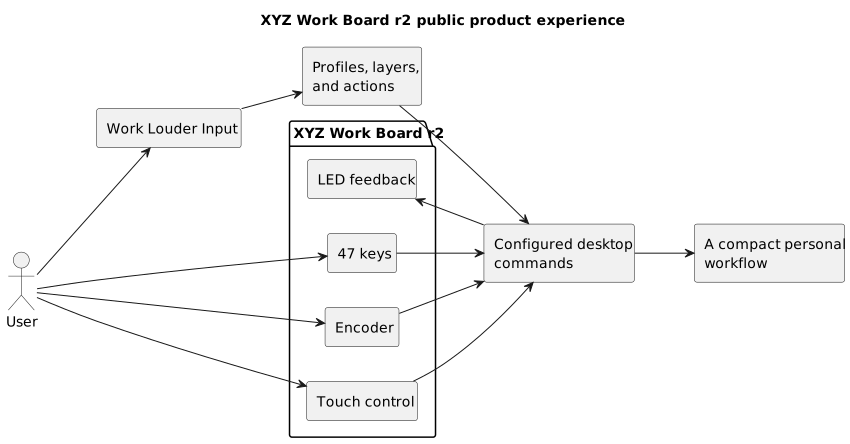
The configurator and keyboard controls converge into a compact personal workflow. The diagram represents the public experience only.
My contribution
I contributed to the firmware that turns the hardware platform into product behavior.
My work included:
- developing the behavior of the physical controls;
- connecting configurable functions to the device experience;
- supporting integration with Work Louder Input;
- keeping the relationship between configuration and product response clear;
- validating the keyboard in realistic usage scenarios;
- continuing to support corrections and further iterations.
The goal was to make the transition between a choice in the configurator and the behavior observed on the keyboard feel natural. Customization should expand what the device can do without making it unpredictable.
My contribution followed the product from initial integration into continued maintenance. That means going beyond making individual controls respond and building behavior coherent enough to support configuration, repeated use, and further iterations.
A board becomes a product through behavior
Physical components define what a keyboard can detect. Firmware defines what those controls mean to the user.
On XYZ Work Board r2, behavior needs to connect:
- the physical position of a control;
- the selected profile;
- the active layer;
- the configured action;
- feedback that makes the outcome visible.
These concepts belong to the public product experience. My work is to make them cooperate predictably so that the complexity of customization does not become the user's burden.
Firmware shaped around use
I developed the project from the perspective of the final experience: input, configuration, and feedback need to maintain an understandable relationship.
That requires attention both to the hardware-facing work and to the behavior users perceive. Firmware becomes the connection between the physical capabilities of the product and the way it is adapted to a personal workflow.
A configurable control should not change meaning unexpectedly. When the user moves to another profile or modifies an action, the device should continue to offer clear points of reference.
I therefore worked to keep a clear relationship between configuration and use: Input defines the behavior, while the keyboard applies and communicates it consistently.
Configurability without disorder
A programmable keyboard can offer many combinations, but the number of options does not automatically create a good experience.
To keep flexibility useful, I consider:
- initial behavior that makes the product immediately usable;
- predictable organization of layers and profiles;
- coherent responses across keys, the encoder, and touch control;
- enough feedback to understand the current context;
- the ability to change behavior without making everyday use fragile.
The goal is to give people freedom while maintaining rules in the firmware that make that freedom manageable.
Validating what the user will actually do
Firmware quality emerges when configuration and use are tested together. Checking an isolated key is not enough: complete sequences, profile changes, rotary input, and transitions between different actions need to be observed.
I used that perspective during development and continue to apply it in maintenance. Each correction or new possibility is evaluated within the complete product, with attention to regressions and configuration continuity.
From first use to maintenance
Following XYZ Work Board r2 across several phases allowed me to maintain a connection between early decisions and later use. Firmware work does not end when the product becomes available: corrections, refinements, and new needs continue to emerge.
That continuity supports more precise changes because each one is considered in relation to the experience already built.
Outcome
My contribution helped turn XYZ Work Board r2 from a hardware platform into a configurable and maintainable product.
The project shows my ability to support embedded firmware across the product journey, from initial integration to validation and continued maintenance.
It also demonstrates a principle I often apply: the quality of a programmable platform depends on how many possibilities are organized into simple behavior.
What this project says about my work
XYZ Work Board r2 demonstrates:
- complete development of embedded product behavior;
- integration between physical controls and software configuration;
- attention to continuity across layers, profiles, and actions;
- validation through realistic usage scenarios;
- maintenance after the product becomes publicly available.