Creator Micro 2 · firmware evolution
I contribute to the evolution of Creator Micro 2 firmware, focusing on reliability, coherent behavior, and continuity for its existing user experience.
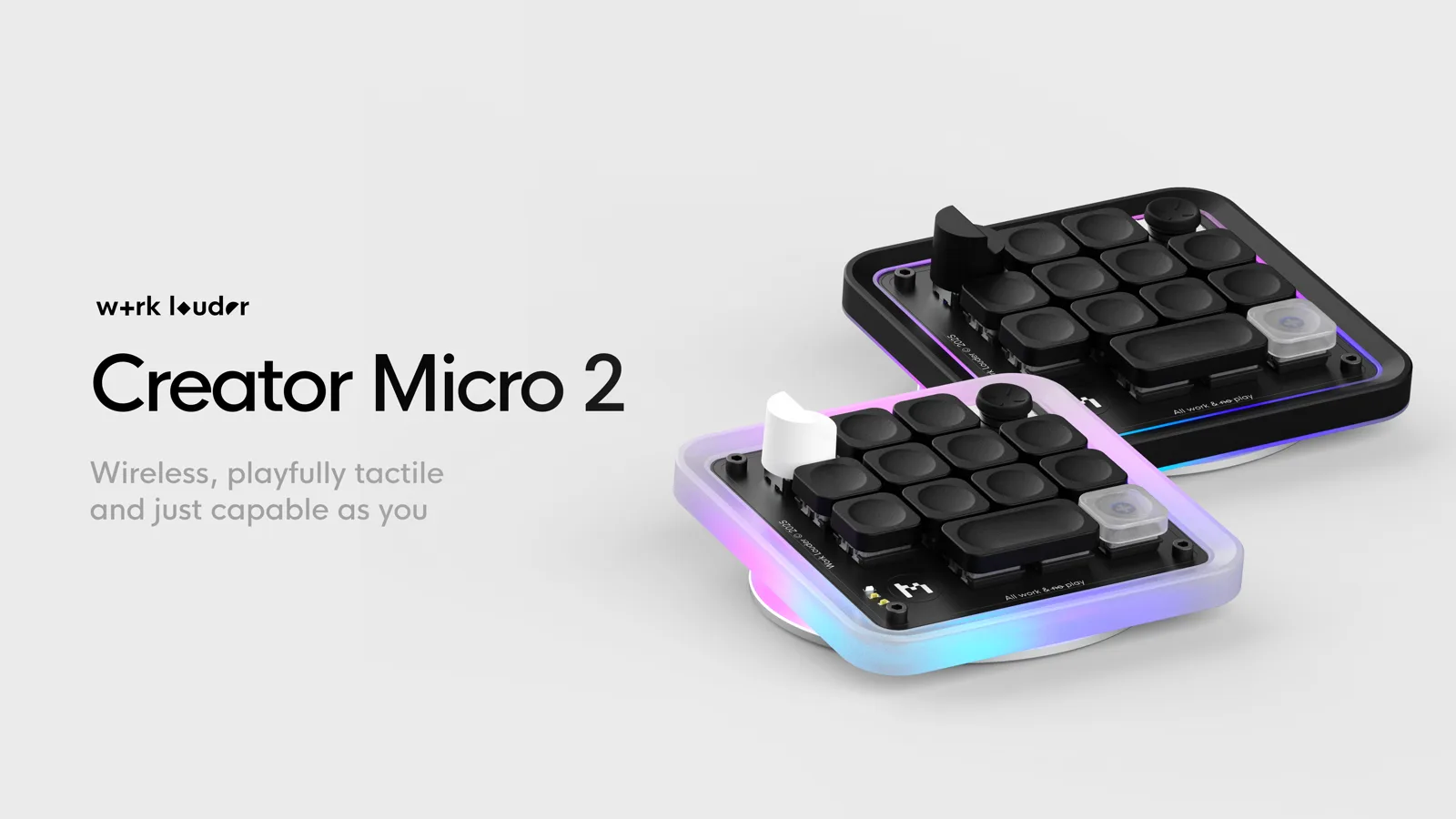
Evolving an existing product
Creator Micro 2 is Work Louder's compact creative controller. It combines keys, programmable controls, lighting, and software configuration to provide broad functionality within a small footprint.
Working on a product that people already use requires balance. New possibilities need to arrive without making existing habits and configurations less understandable.

Creator Micro 2, a programmable controller developed by Work Louder.
The product brings together thirteen mechanical keys, a rotary control, a joystick, a touch control, and RGB lighting. Through Work Louder Input, these elements can be organized into layers and presets connected to the working context.
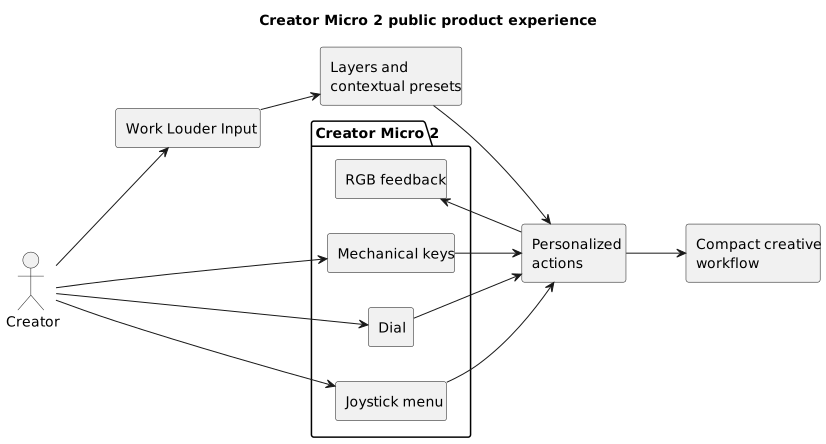
Input and the physical controls create a personal workflow within a compact footprint. The diagram describes only the public capabilities of the product.
My contribution
I joined the project to contribute to the evolution and consolidation of its firmware.
My work focuses on:
- developing and maintaining device features;
- improving reliability across different modes of use;
- keeping controls, configuration, and feedback coherent;
- preserving expected behavior as the product evolves;
- making the firmware easier to verify and maintain;
- collaborating with the team through testing, corrections, and new iterations.
The value does not come from one feature. It comes from enabling several parts of the product to evolve without losing continuity across the experience.
On an existing product, a technically correct change can still be wrong if it surprises the user, alters a habit without a reason, or makes the relationship between control and result less clear. My work therefore starts from behavior that users already recognize.
Understanding before changing
Joining an established firmware project requires a different kind of attention from starting with an empty codebase. Before changing it, I need to understand which decisions are intentional, which behaviors belong to the product identity, and which relationships have become important over time.
I approached Creator Micro 2 through the complete user journey:
- configuring the device;
- selecting the working context;
- using keys and controls;
- receiving understandable feedback;
- returning to the same environment after an update or a new session.
That perspective prevents the firmware from becoming a collection of isolated modules. Each change is evaluated through the effect it has on the complete product.
Continuity before novelty
My work on Creator Micro 2 starts from behavior that users already understand. Each change needs to consider existing configurations, different ways of using the device, and its relationship with Work Louder Input.
This requires a gradual approach: understand the product as a whole, introduce focused improvements, and verify that its features continue to work together predictably.
Continuity does not mean leaving everything unchanged. It means creating room for new features without requiring people to rebuild the way they work. The firmware should evolve while keeping the concepts users rely on stable.
Reliability is part of the experience
On a programmable controller, reliability is not separate from UX. A configured action should behave consistently when repeated; feedback should match the current context; transitions between different ways of using the device should remain understandable.
I therefore worked on perceived quality as well as functionality:
- coherent responses during extended use;
- predictable behavior in everyday transitions;
- configuration that remains understandable;
- useful feedback without unnecessary noise;
- focused changes that can be verified clearly.
These qualities rarely appear as one visible feature, but they determine whether the product feels dependable.
Maintenance as product development
Maintenance is not limited to correcting something that does not work. It includes understanding needs that emerge from real use, deciding where a new possibility belongs, and keeping the product orderly as it grows.
On Creator Micro 2, this work happens in collaboration with the Work Louder team, connecting development, testing, and product priorities. Each iteration needs to be clear enough to verify and compatible enough not to interrupt the workflows users have already built.
Outcome
The work contributes to firmware that is more dependable and easier to evolve while keeping the Creator Micro 2 experience recognizable.
The project represents an important part of my embedded work: not only creating new features, but consolidating real products and supporting them over time.
It has also allowed me to treat continuity as both a technical and product requirement: evolving the device without losing what makes it useful.
What this project says about my work
Creator Micro 2 demonstrates my ability to:
- join an existing firmware codebase and understand its behavior;
- preserve the experience while the product changes;
- connect configuration, controls, and feedback;
- work on long-term reliability and maintainability;
- turn maintenance into a continuous improvement process.