
Introduzione
Da quando ho iniziato a lavorare con Qt, mi sono chiesto come si potesse implementare un meccanismo signal/slot usando il C++ moderno.
Wikipedia lo definisce così.
[...] a language construct [...] which makes it easy to implement the Observer pattern while avoiding boilerplate code. The concept is that GUI widgets can send signals containing event information which can be received by other controls using special functions known as slots.
-- Wikipedia
In termini più semplici, il meccanismo signal/slot consente agli oggetti di comunicare attraverso eventi. Esistono già ottime librerie che implementano questo pattern; in questo articolo presento una piccola soluzione personale, costruita soprattutto per comprenderne meglio il funzionamento.
Diagramma UML
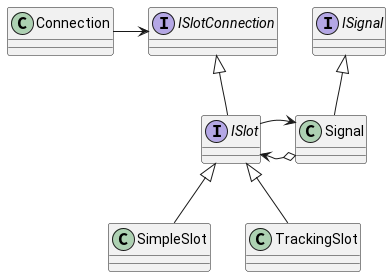
Il diagramma seguente riassume la struttura del progetto.
Codice
Poiché l'implementazione usa classi template, il codice si trova interamente in un file header. I commenti nel sorgente descrivono responsabilità e comportamento dei componenti principali.
#ifndef LIBSIGSLOTPP_INCLUDE_LIBSIGSLOTPP_SIGNAL_HPP_#define LIBSIGSLOTPP_INCLUDE_LIBSIGSLOTPP_SIGNAL_HPP_#include <functional>#include <memory>namespace sigslotpp {typedef std::size_t IDType;/** * @brief Interface ISlotConnection * It provides a simple interface that identifies the Slot and its main * connectivity operations. * ISignal can access private and protected regions for design purposes. */class ISlotConnection {private: friend class ISignal; IDType id_; ///< identifier and index into the signal slots vector. bool isConnected_; ///< slot connection status. bool isBlocked_; ///< slot connection block status.protected: /** * @brief Getter for the identifier * @return id_ */ IDType id() const noexcept { return id_; } /** * @brief Getter/Setter for the identifier * @return a reference to id_ */ IDType& id() noexcept { return id_; } /** * @brief Clears the slot connection * Where the real disconnection happens. * This gets called by the ISlotConnection::disconnect() function, the * implementation depends on the child subclasses. */ virtual void clear() noexcept = 0;public: ISlotConnection() = delete; // not needed but better for compilation error /** * @brief Primary constructor * @post id_ == id * @post isConnected__ == isConnected * @post isBlocked_ == isBlocked */ explicit ISlotConnection( IDType const id, bool const isConnected = true, bool const isBlocked = false ) noexcept : id_(id), isConnected_(isConnected), isBlocked_(isBlocked) {} /** * @brief Destructor */ virtual ~ISlotConnection() {}public: /** * @brief Checks the connection status * Used to see if a slot is still connected to a Signal */ virtual bool isConnected() const noexcept { return isConnected_; } /** * @brief Checks if the connection is blocked * Used to temporarily disable slot invocation. * @return true if the slot invocation is blocked else false. */ bool isBlocked() const noexcept { return isBlocked_; }public: /** * @brief Blocks the slot invocation * @post isBlocked_ == true */ void block() noexcept { isBlocked_ = true; } /** * @brief Unblocks the slot invocation * @post isBlocked_ == false */ void unblock() noexcept { isBlocked_ = false; } /** * @brief Disconnects the slot from the signal * @post isConnected_ == false */ void disconnect() { if (isConnected_) { isConnected_ = false; clear(); } }};/** * @brief Class Connection * This class allows interaction with an ongoing signal-slot connection and * exposes an interface to manipulate and query the status of this connection. * Note that Connection is not a RAII object, one does not need to hold one * such object to keep the signal-slot connection alive. */class Connection {private: std::weak_ptr<ISlotConnection> slot_; ///< the slot to manipulate and querypublic: Connection() = delete; // not needed but better for compilation error /** * @brief Primary constructor * @param slot that will be handled by this connection */ explicit Connection(std::weak_ptr<ISlotConnection>&& slot) : slot_(slot) {} /** * @brief Destructor */ virtual ~Connection() {}public: /** * @brief Checks if this connection is still valid * To have this information just see if the std::weak_ptr is expired * @return true if the connection is valid else false */ bool isValid() const noexcept { return !slot_.expired(); } /** * @brief Checks if the slot is still connected to its signal * @return true if the slot is still connected else false * @see ISlotConnection::isConnected() */ bool isConnected() const noexcept { std::shared_ptr<ISlotConnection> d = slot_.lock(); return d && d->isConnected(); } /** * @brief Checks if the slot connection is blocked * @return true if the slot connection is blocked else false * @see ISlotConnection::isBLocked() */ bool isBlocked() const noexcept { std::shared_ptr<ISlotConnection> d = slot_.lock(); return d && d->isBlocked(); } /** * @brief Blocks the slot invocation * @see ISlotConnection::block() */ void block() noexcept { std::shared_ptr<ISlotConnection> d = slot_.lock(); if (d) d->block(); } /** * @brief Unblocks the slot invocation * @see ISlotConnection::unblock() */ void unblock() noexcept { std::shared_ptr<ISlotConnection> d = slot_.lock(); if (d) d->unblock(); } /** * @brief Disconnects the slot from its signal * @see ISlotConnection::disconnect() */ void disconnect() { std::shared_ptr<ISlotConnection> d = slot_.lock(); if (d) d->disconnect(); }};////////////////////////////////** * @brief Interface ISignal * It provides a simple interface that identifies the Signal and its essential * functions. */class ISignal {protected: /** * @brief Getter for specified ISlotConnection identifier * @return id of the specified slot */ IDType idOf(ISlotConnection* const slotPtr) const noexcept { return slotPtr->id(); } /** * @brief Getter/Setter for specified ISlotConnection identifier * @return a reference to id of the specified slot */ IDType& idOf(ISlotConnection* const slotPtr) noexcept { return slotPtr->id(); }public: /** * @brief Destructor */ virtual ~ISignal() {} /** * @brief Disconnect the slot from this signal * @param slot a pointer to the slot to disconnect from */ virtual void disconnect(ISlotConnection* const slot) = 0;};/** * @brief Interface ISlot * It provides a simple interface that identifies the Slot and its core * invocation functionality. * @tparam Args... the argument types of the function to call */template <typename... Args>class ISlot : public ISlotConnection {private: ISignal& signal_; ///< reference to the signalprotected: /** * @brief Clears the slot connection */ virtual void clear() noexcept override { signal_.disconnect(this); } /** * @brief Invokes the function * Where the function is really invoked. * This gets called by the ISlot::operator()() function, the * implementation depends on the child subclasses. * @param args the arguments of the function to call */ virtual void invoke(Args... args) = 0;public: ISlot() = delete; // not needed but better for compilation error /** * @brief Primary constructor * We have a reference that must be initialized, so no default constructor * allowed here. * @param id the slot identifier * @param signal the reference of the signal connected to this slot * @post signal_ points to the signal connected to this slot * @see ISlotConnection */ ISlot(IDType const id, ISignal& signal) noexcept : ISlotConnection(id), signal_(signal) {} /** * @brief Invokes the function * Invokes or calls the function stored in the slot. * Take note that i add an extra template here for flexibility and design * purposes. As mentioned in Signal::emit() we use the signature here. * At the end it is used std::forward to forward lvalues as either lvalues * or as rvalues, depending on Params. * @see Signal::emit() * @param params the parameters of the function to call * @tparam ...Params types of the parameters of the function to call */ template <typename... Params> void operator()(Params&&... params) { if (ISlotConnection::isConnected() && !ISlotConnection::isBlocked()) invoke(std::forward<Params>(params)...); }};/** * @brief Class SimpleSlot * Basic slot that does not track anything and thus it is imperative that what * is called by the std::function must exceeds the lifetime of signal this * slot is connected to. * @tparam Args... the argument types of the function to call */template <typename... Args>class SimpleSlot final : public ISlot<Args...> {private: std::function<void(Args...)> function_; ///< function to be invoked by this slotprotected: /** * @copydoc ISlot::invoke() */ void invoke(Args... args) override final { function_(std::forward<Args>(args)...); }public: SimpleSlot() = delete; // not needed but better for compilation error /** * @brief Primary constructor * @param id the slot identifier * @param function to be invoked by this slot * @param signal the reference to the signal this slot is connected to * @see ISlot */ SimpleSlot(IDType const id, std::function<void(Args...)>&& function, ISignal& signal) noexcept : ISlot<Args...>(id, signal) , function_(std::forward<std::function<void(Args...)>>(function)) {}};/** * @brief Class TrackingSlot * Tracking slot that tracks an object with a std::weak_ptr, it is auto * disconnected upon expiration of the std::weak_ptr thus no need to take care * of complex object lifetime managment. * @tparam T the type of the object to track * @tparam Args... the argument types of the function to call */template <typename T, typename... Args>class TrackingSlot final : public ISlot<Args...> {private: std::function<void(Args...)> function_; ///< function to be invoked by this slot std::weak_ptr<T> objectPtr_; ///< the pointer to the object this slot is trackingprotected: /** * @copydoc ISlot::invoke() */ void invoke(Args... args) override final { // this is probably useless in signle thread auto sp = objectPtr_.lock(); if (!sp) { ISlotConnection::disconnect(); return; } if (ISlotConnection::isConnected()) { function_(args...); } }public: TrackingSlot() = delete; // not needed but better for compilation error /** * @brief Primary constructor * @param id the slot identifier * @param objectPtr the pointer to the object to track * @param function to be invoked by this slot * @param signal the reference to the signal this slot is connected to * @see ISlot */ TrackingSlot( IDType const id, std::weak_ptr<T>&& objectPtr, std::function<void(Args...)>&& function, ISignal& signal ) noexcept : ISlot<Args...>(id, signal) , function_(std::forward<std::function<void(Args...)>>(function)) , objectPtr_(std::forward<std::weak_ptr<T>>(objectPtr)) {}public: /** * @brief Checks if the connection still there */ bool isConnected() const noexcept override final { return !objectPtr_.expired() && ISlotConnection::isConnected(); }};/** * @brief Class Signal * This class manages a collection of ISlots * @tparam R the return type of the function to call * @tparam Args... the argument types of the function to call */template <typename R, typename... Args>class Signal final : public ISignal {private: std::vector<std::shared_ptr<ISlot<Args...>>> slots_; ///< slots connected to this Signal /** * @brief Disconnects the specified slot * @param slot the pointer to the slot to disconnect from * @post slots_.size() decremented by one */ void disconnect(ISlotConnection* const slot) noexcept override final { IDType index = idOf(slot); if (!slots_.empty()) { std::swap(slots_[index], slots_.back()); idOf(slots_[index].get()) = index; slots_.pop_back(); } }public: /** * @brief Default constructor * @post slots_.size() == 0 */ Signal() noexcept : slots_() {} /** * @brief Destructor */ virtual ~Signal() noexcept { disconnectAll(); } /** * @brief Move constructor * @see Signal::operator=() */ Signal(Signal&& other) noexcept : slots_() { *this = std::move(other); } /** * @brief Move assignment operator * @return a reference to this * @post slots_ == other.slots_ */ Signal& operator=(Signal&& other) noexcept { if (this != &other) { slots_ = std::move(other.slots_); } return *this; } /** * @brief Connects a slot to the signal * Connects a std::function to the signal. * @param function the signal connects to * @return a Connection instance for managment purposes * @post slots_.size() incremented by one */ Connection connect(std::function<R(Args...)>&& function) noexcept { IDType id = slots_.size(); std::shared_ptr<ISlot<Args...>> slot = std::make_shared<SimpleSlot<Args...>>( id, std::forward<std::function<R(Args...)>>(function), *this ); slots_.push_back(slot); return Connection(std::weak_ptr(slots_[id])); } /** * @brief Connects and tracks a slot to the signal * Connects a std::function to the signal but this time the slot is tracked * by a std::weak_ptr pointing to the object of type T. The purpose is to * disconnect this slot automatically upon said object destruction. * @param function the signal connects to * @param objectPtr pointer to the object to be tracked * @tparam T the type of the object to track * @return a Connection instance for managment purposes * @post slots_.size() incremented by one */ template <typename T> Connection connect(std::weak_ptr<T>&& objectPtr, std::function<R(Args...)>&& function) noexcept { IDType id = slots_.size(); std::shared_ptr<ISlot<Args...>> slot = std::make_shared<TrackingSlot<T, Args...>>( id, std::forward<std::weak_ptr<T>>(objectPtr), std::forward<std::function<R(Args...)>>(function), *this ); slots_.push_back(slot); return Connection(std::weak_ptr(slots_[id])); } /** * @brief Connects and tracks a slot to the signal * Convenience method to connect a member function. * Connects a function pointer to the signal. * The slot is tracked by a std::weak_ptr pointing to the object of type T. * The purpose is to disconnect this slot automatically upon said object * destruction. * @param function pointer the signal connects to * @param objectPtr pointer to the object to be tracked * @tparam T the type of the object to track * @return a Connection instance for managment purposes * @post slots_.size() incremented by one */ template <typename T> Connection connect(std::shared_ptr<T>& objectPtr, R (T::*function)(Args...)) noexcept { T* const ptr = objectPtr.get(); return connect(std::weak_ptr<T>(objectPtr), [ptr, function](Args... args) -> R { return (ptr->*function)(args...); }); } /** * @brief Connects and tracks a slot to the signal * Convenience method to connect a const member function. * Connects a function pointer to the signal. * The slot is tracked by a std::weak_ptr pointing to the object of type T. * The purpose is to disconnect this slot automatically upon said object * destruction. * @param function pointer the signal connects to * @param objectPtr pointer to the object to be tracked * @tparam T the type of the object to track * @return a Connection instance for managment purposes * @post slots_.size() incremented by one */ template <typename T> Connection connect(std::shared_ptr<T>& objectPtr, R (T::*function)(Args...) const) noexcept { T* const ptr = objectPtr.get(); return connect(std::weak_ptr<T>(objectPtr), [ptr, function](Args... args) -> R { return (ptr->*function)(args...); }); } /** * @brief Disconnects all the slots * Disconnects all the slots this signal is connected to. * @post slots_.empty() == true */ void disconnectAll() noexcept { slots_.clear(); } /** * @brief Emits the signal * All non blocked and connected slot functions will be called * with supplied arguments. * Important explanation! * A template is used here, this is for flexibility and design purposes. * To this function can be passed rvalues or lvalues but if we use the Args * type it is basically precluding us to emit the signal when it is a * different types from Args. Suppose Signal<bool, int, double&> the matched * function is std::function<bool(int, double&)>. Now i can't emit something * like emit(5, 5.0) because 5.0 is a non const lvalue. * @see ISlot::operator()() * @param params arguments to emit * @tparam ...Params type of the parameter to emit */ template <typename... Params> void emit(Params... params) { for (auto const& it : slots_) { it->operator()(params...); } } /** * @brief Gets the number of connected slots * @return slots.size() */ std::size_t connectedSlots() const noexcept { return slots_.size(); }};} // namespace sigslotpp#endif // LIBSIGSLOTPP_INCLUDE_LIBSIGSLOTPP_SIGNAL_HPP_Utilizzo
Per comprendere come utilizzare la soluzione implementata vi mostro gli unit tests che ho scritto.
std::string const ff = "free function";std::string const mf = "member function";std::string const smf = "static member function";std::string const mo = "member operator";std::string const l = "lambda";std::string const gl = "generic lambda";void f() { fmt::print("{}\n", ff);}struct s { void m() { fmt::print("{}\n", mf); } static void sm() { fmt::print("{}\n", smf); }};struct o { void operator()() { fmt::print("{}\n, mo"); }};TEST_CASE("slots can be added and removed from the signal") { std::shared_ptr<s> d; auto lambda = []() { fmt::print("{}\n", l); }; auto gen_lambda = [](auto&&... a) { fmt::print("{}\n", gl); }; sigslotpp::Signal<void> sig; SUBCASE("connecting slots to signal increases connected slots") { auto c1 = sig.connect(f); sig.connect(d, &s::m); sig.connect(&s::sm); auto c2 = sig.connect(o()); sig.connect(lambda); sig.connect(gen_lambda); CHECK(sig.connectedSlots() == 6); } SUBCASE("discconnecting all slots from the signal put size to zero") { auto c1 = sig.connect(f); auto c2 = sig.connect(o()); sig.connect(lambda); sig.connect(gen_lambda); sig.disconnectAll(); CHECK(sig.connectedSlots() == 0); } SUBCASE("disconnecting slots from signal decreases connected slots") { auto c1 = sig.connect(f); auto c2 = sig.connect(o()); c1.disconnect(); CHECK(sig.connectedSlots() == 1); }}TEST_CASE("signal can be emitted") { int x{0}; auto lambda = [&x](int value) { x = x + value; }; sigslotpp::Signal<void, int> sig; sig.connect(lambda); sig.emit(5); CHECK(x == 5); sig.emit(1); CHECK(x == 6); sig.emit(-6); CHECK(x == 0);}int sum = 0;struct x { void f(int i) { sum += i; }};TEST_CASE("signal can be automatically disconnected") { auto a = std::make_shared<x>(); sigslotpp::Signal<void, int> sig; sig.connect(a, &x::f); sig.emit(4); sig.emit(3); sig.emit(-2); CHECK(sum == 5); a.reset(); sig.emit(9); CHECK(sum == 5); CHECK(sig.connectedSlots() == 0);}TEST_CASE("signal connection to slot can be blocked") { int x{0}; auto lambda = [&x](int value) { x = x + value; }; sigslotpp::Signal<void, int> sig; auto c1 = sig.connect(lambda); sig.emit(5); CHECK(x == 5); c1.block(); sig.emit(1); CHECK(x == 5); c1.unblock(); sig.emit(-6); CHECK(x == -1);}Analisi
Le classi coinvolte sono:
- ISlotConnection
- ISlot
- SimpleSlot
- TrackingSlot
- ISignal
- Signal
- Connection
Non serve analizzare ogni classe riga per riga; due elementi, però, meritano una spiegazione più attenta: TrackingSlot e Connection.
Classe TrackingSlot
Questa classe permette, tramite un std::weak_ptr, di tracciare l'esistenza in memoria di un oggetto specifico. Per questo la soluzione presuppone l'uso degli smart pointer, in particolare di un std::shared_ptr per creare l'oggetto da tracciare.
Quando il weak_ptr non riesce più a eseguire il lock, significa che l'oggetto tracciato ha terminato il suo ciclo di vita.
Lo slot non viene rimosso immediatamente quando l'oggetto termina il suo ciclo di vita, ma al successivo emit del signal a cui è connesso.
Va chiarito che questa classe non modifica il ciclo di vita dell'oggetto tracciato.
Classe Connection
Questa classe non segue il pattern RAII.
Serve come punto di accesso esplicito alla connessione tra signal e slot.
Connection mantiene un riferimento, un weak_ptr, allo slot creato in seguito a una chiamata signal.connect(...).
La classe può operare sulle seguenti funzioni dello slot:
- Disconnessione
- Blocco/sblocco della ricezione di un'emissione di signal
- Verifica dello stato dello slot
Va chiarito che il ciclo di vita di questa classe non modifica il ciclo di vita dello slot.
Problemi aperti
Vi sono nell'immediato alcune lacune dal punto di vista funzionale, poiché:
- Non è thread safe.
- Non posso disconnettermi direttamente dallo slot (immaginiamo un segnale che deve essere emesso una sola volta).
- Overloading dei metodi.
- Metodi con valori default.
- Non c'è modo di recuperare il valore di ritorno degli slot.
Il punto 1 non viene affrontato qui, data la complessità della gestione thread-safe.
Sul punto 4 non ho ancora trovato una soluzione soddisfacente.
Il problema 5 nasce solo per motivi progettuali, ho preferito non implementarlo perché superfluo per lo scopo della classe Signal. Nella mia implementazione è possibile connettersi a slot con valore di ritorno, che vengono poi trasformati in slot con ritorno void. Per implementare il valore di ritorno servirebbe un vettore di appoggio in cui salvare il ritorno di ogni slot e mettere a disposizione dei metodi per leggerlo. Ogni emit sovrascriverebbe quel vettore.
Problema: disconnessione diretta dallo slot
La classe Connection risolve questo problema in modo diretto.
Basta aggiungere una classe ExtendedSlot che abbia come membro una variabile di tipo Connection, così da poterla iniettare
all'interno della funzione invoke. Tuttavia c'è un compromesso, ovvero dovremmo disporre di funzioni che abbiano come
parametro un tipo Connection.
Vediamo una possibile soluzione.
Aggiungiamo una classe ExtendedSlot.
template <typename... Args>class ExtendedSlot final : public ISlot<Args...> {private: std::function<void(Args...)> function_; ///< function to be invoked by this slotConnection connection_ ///< connection handle injected into the slot protected : void invoke(Args... args) override final { function_(connection_, std::forward<Args>(args)...); }public: ExtendedSlot(IDType const id, std::function<void(Args...)>&& function, ISignal& signal) noexcept : ISlot<Args...>(id, signal) , function_(std::forward<std::function<void(Args...)>>(function)) {} // Not ideal, but enough for this implementation. void setConnection(Connection connection) { connection_ = connection }};Modifichiamo Signal e aggiungiamo un metodo connectExtended.
Connection connectExtended(std::function<R(Args...)>&& function) noexcept { IDType id = slots_.size(); std::shared_ptr<ISlot<Args...>> slot = std::make_shared<ExtendedSlot<Args...>>( id, std::forward<std::function<R(Args...)>>(function), *this ); slots_.push_back(slot); auto c = Connection(std::weak_ptr(slots_[id])); slots_[id]->setConnection(c); return c;}E per utilizzarlo avremo.
int main() { int i = 0; sigslot::signal<void> sig; auto f = [](auto& con) { i += 1; con.disconnect(); }; sig.connectExtended(f);}Rimane il limite di dover aggiungere sempre quel parametro di tipo Connection a ogni slot, per di più come primo argomento.
Problema: overloading
Aggiungendo le seguenti funzioni di supporto possiamo risolvere anche questo caso.
template <typename T, typename R, typename... Args>constexpr auto overload(R (I::*ptr)(Args...)) { return ptr;}template <typename R, typename... Args>constexpr auto overload(R (*ptr)(Args...)) { return ptr;}Il parameter pack, una volta espanso, permette di identificare il metodo corretto in modo univoco:
struct obj { void operator()(int) const {} void operator()() {}};struct foo { void bar(int) {} void bar() {} static void baz(int) {} static void baz() {}};void moo(int) {}void moo() {}int main() { sigslot::signal<void, int> sig; foo ff; sig.connect(overload<int>(&foo::bar), &ff); sig.connect(overload<int>(&foo::baz)); sig.connect(overload<int>(&moo)); sig.connect(obj()); sig(0); return 0;}Conclusione
Abbiamo visto come implementare un meccanismo di signal/slot. La soluzione ha limiti evidenti, ma offre un'interfaccia d'uso semplice e senza meccanismi nascosti.
Con questa base possiamo implementare l'observer pattern in modo chiaro e controllabile.
A questo link trovate la cartella di progetto che potrete compilare con CMake.
Ultimo aggiornamento
2026-01-20.
Sorgente dell’articolo content/blog/signals_and_slots.